Solibri API - Launching Solibri Autorun
On Windows, you can launch Solibri Autorun in three ways:
- Create a desktop shortcut.
- Create a batch file (
.bat). - Run the XML file from the command prompt.
On macOS, run Autorun from the command line (see below).
In each case, start Solibri and pass the path to your Autorun XML file as the command-line argument.
Using a Shortcut to Launch Solibri Autorun
Create a shortcut on your desktop and add the paths to Solibri and the Autorun XML file in the Target field. For example, copy the existing Solibri shortcut and edit its properties:
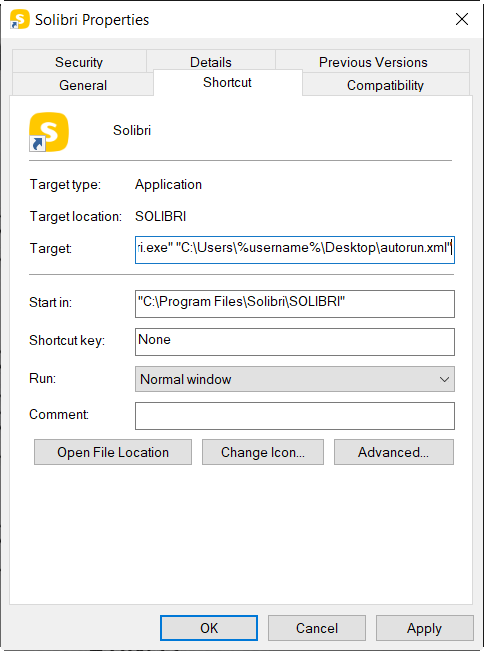
Rename the shortcut, for example to Solibri Autorun.
Using a Batch File to Launch Solibri Autorun
A batch (.bat) file is a text file that Command Prompt runs line by line. You can use one to start Solibri Autorun and optionally print status messages.
To create a batch file:
-
Create a new text file in any text editor.
-
Add the paths to Solibri and your Autorun XML file. To close Command Prompt when Autorun finishes, add
exitat the end. You can also add other commands if needed:
@ECHO off

ECHO Thank you for using Autorun
ECHO Autorun is running...

REM You can modify the line below to suit your needs.
"C:\Program Files\Solibri\SOLIBRI\Solibri.exe" "C:\Users\%Username%\Desktop\autorun.xml"

exit
-
Save the file.
-
Change the file extension to
.bat.
 |
|---|
| If you use a batch file to launch Solibri Autorun, you can use Task Scheduler to run the batch file automatically at a scheduled time. |
Using Command Prompt to Launch Solibri Autorun
Open Command Prompt and run Solibri with the path to your XML file as an argument:
"C:\Program Files\Solibri\SOLIBRI\Solibri.exe" "C:\path\to\autorun.xml"
Use quotes around paths that contain spaces.
Using the Terminal on macOS
Open Terminal and run:
/Applications/Solibri/Solibri.app/Contents/MacOS/Solibri "/path/to/autorun.xml"
Solibri is typically installed in /Applications/Solibri. Use quotes around paths that contain spaces.